
Independent comparison publishing — since 2017
Private Label Perfume: 7 Mistakes to Avoid in a Kids-Safe Line
Most private label perfume lines for children fail on procedure, not on scent. The recurring mistakes are ingredient choices that ignore fragrance-safety frameworks, packaging that looks child-friendly but is not, and labels that leave out the one line parents actually read. Each of these is cheap to fix in the brief and expensive to fix after bulk production. This article walks through the seven that come up most often and what to do instead.
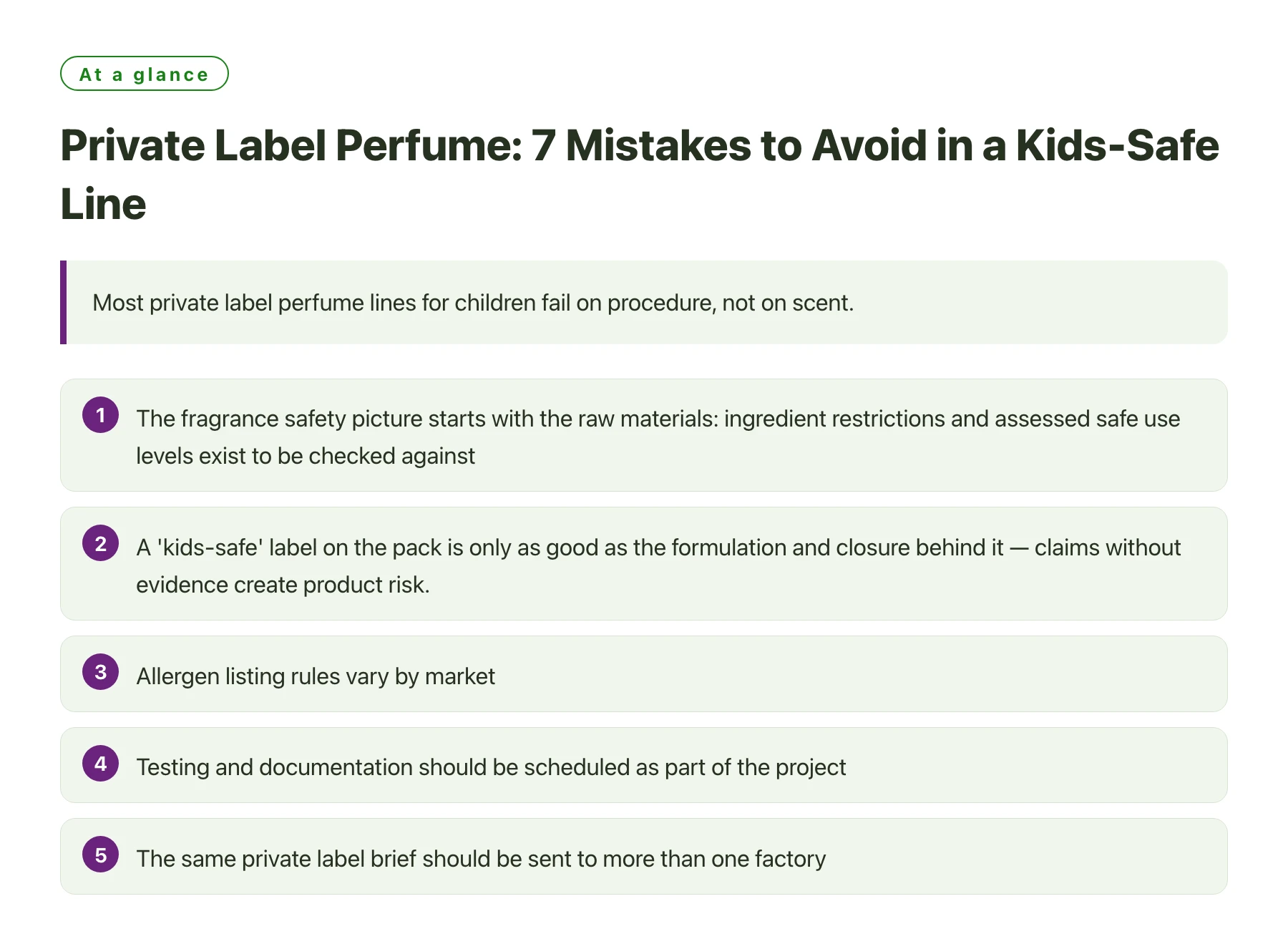
Key takeaways
- The fragrance safety picture starts with the raw materials: ingredient restrictions and assessed safe use levels exist to be checked against, not discovered later [1].
- A 'kids-safe' label on the pack is only as good as the formulation and closure behind it — claims without evidence create product risk.
- Allergen listing rules vary by market, and getting them wrong in one export market can stop the whole shipment.
- Testing and documentation should be scheduled as part of the project, not added when a retailer asks for them.
- The same private label brief should be sent to more than one factory, because responses reveal how seriously each one takes the category.
Private label is how most new fragrance brands start: you choose a base or a direction, the manufacturer develops or adapts it, and the product carries your name. Done well, it is the fastest route to shelf. Done carelessly, it produces a line that looks fine to the founder and quietly fails every check a distributor runs.
For a line intended to be used around children, the failure modes are specific. The list below comes from what actually goes wrong — ingredient decisions, packaging shortcuts, missing paperwork — not from theory.
The mistakes that show up in kids-safe private label lines
The seven mistakes below are ordered roughly by how early in the project they should have been caught. If you recognise more than two of them in your current plan, treat it as a normal finding — the point of a mistakes list is that most of them are preventable.
A quick framing note: 'private label' usually means you are not commissioning a new formula from scratch. That is exactly why the safety checks below matter more, not less — because an existing base was designed for a general adult profile, and your brief has to pull it toward children's use.
Mistake 1: treating 'kids-safe' as a marketing phrase
If your brief says 'kid-friendly' but contains no formulation limits, no closure requirement and no test list, every supplier will say yes to it. Write the safety assumptions down as specifications, and the conversation changes from vibes to verification.
Mistake 2: skipping the ingredient-level check
Fragrance ingredients have published restriction lists and safe use levels that any formulator can consult, and the EU maintains a public ingredient database where you can see how individual substances are regulated in cosmetics [2]. Ask the manufacturer which materials in your base are restricted, and why each one is present.
Mistake 3: assuming one market's label rules cover the others
Allergen and ingredient labelling differs between the EU, the United States and Canada, and each market keeps its own requirement set. In Canada, for example, cosmetics must meet specific safety and labelling rules before they can be sold, and the manufacturer's notification obligations are separate from labelling [3]. List every market you will ship to and check each one.
Mistake 4: a pretty closure instead of a tested one
A dome cap with rounded edges is not a child-resistant fastening. If the market or the retailer requires child resistance, specify the tested component and keep the panel report. Cosmetics-grade aesthetics and child-resistant mechanics are not mutually exclusive, but you have to ask for both.
Mistake 5: no retained master sample
When the bulk order differs from the approved sample, the first question is always 'which version did we approve?'. A dated, sealed master sample held by both parties answers it without argument.
Mistake 6: paperwork as an afterthought
Stability data, compatibility reports and the formulation document should be produced as the project progresses, not assembled at the end. Retailers and importers will ask for them, and a file that was built forward is a file that is ready.
Mistake 7: shortlisting one supplier
Send the identical written brief to two or three factories and compare the responses line by line. Cheap is not a specification; how the supplier answers the safety questions is.
Mistake, symptom and the fix
| Mistake | Symptom at the review stage | The fix |
|---|---|---|
| 'Kids-safe' as a slogan | Nothing in the spec is verifiable | Turn every claim into a specification |
| No ingredient-level check | Restricted material appears late, or the base was never reviewed | Ask for the restriction review as part of the quote |
| One label for several markets | Compliance stops at the first border | Verify allergen and ingredient rules per market |
| Decorative closure | Fails the child-resistance test that was never booked | Specify the tested component by standard reference |
| No master sample | Bulk order does not match approval, no proof either way | Seal a dated physical sample on both sides |
| Paperwork last | Launch waits on a stability report that takes weeks | Schedule documents into the project plan |
| One supplier | No basis for comparing safety practice | Brief two or three factories identically |
The pattern is the same in every row: the mistake is a decision taken without a downstream owner. Decide who owns safety in your project, and most of the list resolves itself.
Choosing the private label partner for this category
The practical test of a private label supplier for a kids-safe line is simple: does the factory treat the category as routine or as special? A manufacturer that runs both OEM and ODM work will tend to give the same safety discipline to both — both OEM and ODM fragrance production under one quality system means the base you adapt has already been through the same checks as a fully custom project.
For the development side, you want a partner that can turn a short brief into a workable scent rather than pushing a fixed menu — a factory that turns a brief into a scent is the profile that handles a kids-safe brief without losing the product's character. And when you are comparing suppliers, remember that a private label fragrance manufacturer (private label fragrance manufacturer) is being asked to do something specific here: hold your product to a stricter standard than the base it was built from. The one that answers that brief with documentation, not reassurance, is the one to keep.
What to ask at the end of the meeting
Close the supplier meeting with three questions: which ingredients in the proposed base are restricted in my target markets, which closure test applies to my format, and which documents will exist when the order ships. If the answers are crisp and written down, the project is in good hands.
The cheapest mistake in this category is the one you never see because nobody asked. Put the ingredient check, the closure test and the label verification on the same one-page brief you send to every supplier, and let the responses do the evaluation for you.
Sources
- IFRA Standards Library (International Fragrance Association) —— The IFRA Standards Library lists the restrictions the fragrance industry applies to individual fragrance ingredients, based on safety assessments; it is the reference point for compliant fragrance formulation.
- EU CosIng — Cosmetic Ingredient Database (European Commission) —— The European Commission's CosIng database of cosmetic ingredients, listing ingredient functions, restrictions and labelling requirements under EU cosmetics law.
- Health Canada: Cosmetic Safety —— Health Canada's cosmetics pages, covering cosmetic notification, the ingredient hotlist and safety requirements for cosmetics sold in Canada.
Frequently asked questions
Can I use an existing perfume base for a kids-safe line?
Yes, but treat it as a starting point that has to be pulled into a stricter profile, not as a finished answer. Review the restricted ingredients, the concentration, the allergens and the closure, and document each decision for the base you actually ship.
How do I know if an ingredient is restricted?
Start with the restriction frameworks your formulator already works to — published fragrance-material standards, and for the EU the public ingredient database — then ask the manufacturer for the review in writing. The answer should name the substances and the reasons, not just assure you.
Is child-resistant packaging mandatory for children's perfume?
It depends on the market and the formulation's hazard classification; some products are caught by child-resistant fastening requirements, others are not. Check each market in your plan, and if in doubt specify a tested child-resistant closure anyway.
How many suppliers should I brief for a private label line?
Two or three is the practical range. Send the identical written brief to each, including the safety specifications, and compare the answers on ingredients, testing and documentation rather than on price alone.
What paperwork should exist before the first bulk order?
At minimum: the approved formula or base reference, the stability and compatibility results, the closure test report where applicable, and the label file checked against each target market. If the file is finished before production starts, nothing is ever blocked waiting on paper.